Ferrari 250 GT California Spyder
Nice cars, those 1957 Ferraris, their image built on a string of racing victories. Yet, too European for wealthy and spoiled Californians, who still didn’t fully understand exotics like the Tour de France Berlinetta or the Pininfarina Cabriolet. They continued to buy Vettes, T-Birds, even Jags or home-built Hot Rods for drag racing in the streets.
Road-going Ferraris were already a sizeable commercial success in the US thanks to Luigi Chinetti’s promotional effort: he even pushed the Old Man from Maranello to enter an obsolete racer of the terminated Formula 1 at Indy in 1952, where it was outclassed by the mighty pack of domestic roadsters.
Something had to be done to improve sales in the most lucrative US local market: California. The story goes that it was John von Neumann, the West Coast Ferrari distributor, that asked for something tailored to the extroverts driving with the open top to see and be seen under the Californian sun.
The answer from Italy was immediate: Ferrari had already a viable platform in the 250 Berlinetta Tour de France and a reference for the open body in the 250 GT Cabriolet by Pininfarina, ten of which had already been sold in 1957. The prototype of the new roadster for America, s/n 0769GT, was ready at year’s end 1957. The engine was beefed up to 250 bhp at 7,000 rpm (factory figures) for higher performances, thus making it a different proposition than the Cabriolet, heavier and delivering about 220 bhp.
The real hit was the name: California. To stress that it was a brand new car, they completed the product name with the English-sounding “Spyder” Italianate word, just to mean that it was neither a cut down tin top nor another Cabriolet.
We don’t know who the marketing genius was behind such a naming exercise, which was an instant winner. The car deserved the success it encountered: while its shape gave a reassuring image of soundness and evolution rather than revolution, its performance was highly rewarding for street-goers and also quite competitive on the racetrack.
The lightweight, all aluminum models ran successfully at Le Mans and Sebring 1959. Driving s/n 1451GT, Fernand Tavano-Bob Grossman came home fifth overall in France at 103 mph average; Richie Ginther-Howard Hively finished ninth overall and as GT winners at Sebring 12 on s/n 1985GT. In 1960, the aluminum California Spyder s/n 2015GT entered at Le Mans by NART and driven by William Sturgis-Jo Schlesser, recorded a consistent ride up to the eleventh place overall till the engine failed with less than two hours to go.
The California Spyder body had two fathers: Pininfarina and Scaglietti, neither one ever claiming exclusive paternity. Surely, it was designed by the former and built and refined by the latter.
The body was steel with aluminum doors, hood and trunk lid for a total weight of 1,000-1,075 kg (official Ferrari data), i.e. about 100 kg heavier than the TDF Berlinetta. The living space showed a pleasant lack of embellishments: a functional, not stylish, choice for reducing the weight of the car.
Seven units were delivered in the first half of 1958, then a new frame and engine were used to further improve performances. Some 27 units of the so-called “Second Series” were built, including those for racing service.
At the end of 1959, the “Third Series” California appeared: the engine was further modified with ignition on the outside of the banks, like in contemporary racing units. Disc brakes became a standard feature. In about four months, 15 units were produced.
At 1960 Geneva Motor Show, the “Fourth Series” California by Scaglietti was paraded alongside the new 250 SWB Berlinetta: they shared the shorter 2,400 mm wheelbase frame. The ride of the Spyder was improved by hydraulic dampers all around. Power output was raised to 280 bhp.
Besides the shorter body, the main visible difference between the long and short wheelbase versions is in the shape of the air scoop over the engine hood, one of the sexiest details of the California Spyder. In the latter, it is partially recessed.
The short version was apparently issued in 54 units, including three aluminum racing versions. A new frame was used from the end of 1961. The overall production figure is believed to be 104, starting from 41 long wheelbase units in steel and 9 lightweight ones for racing. The final car, s/n 4167GT, was delivered in February 1963 to an American customer.
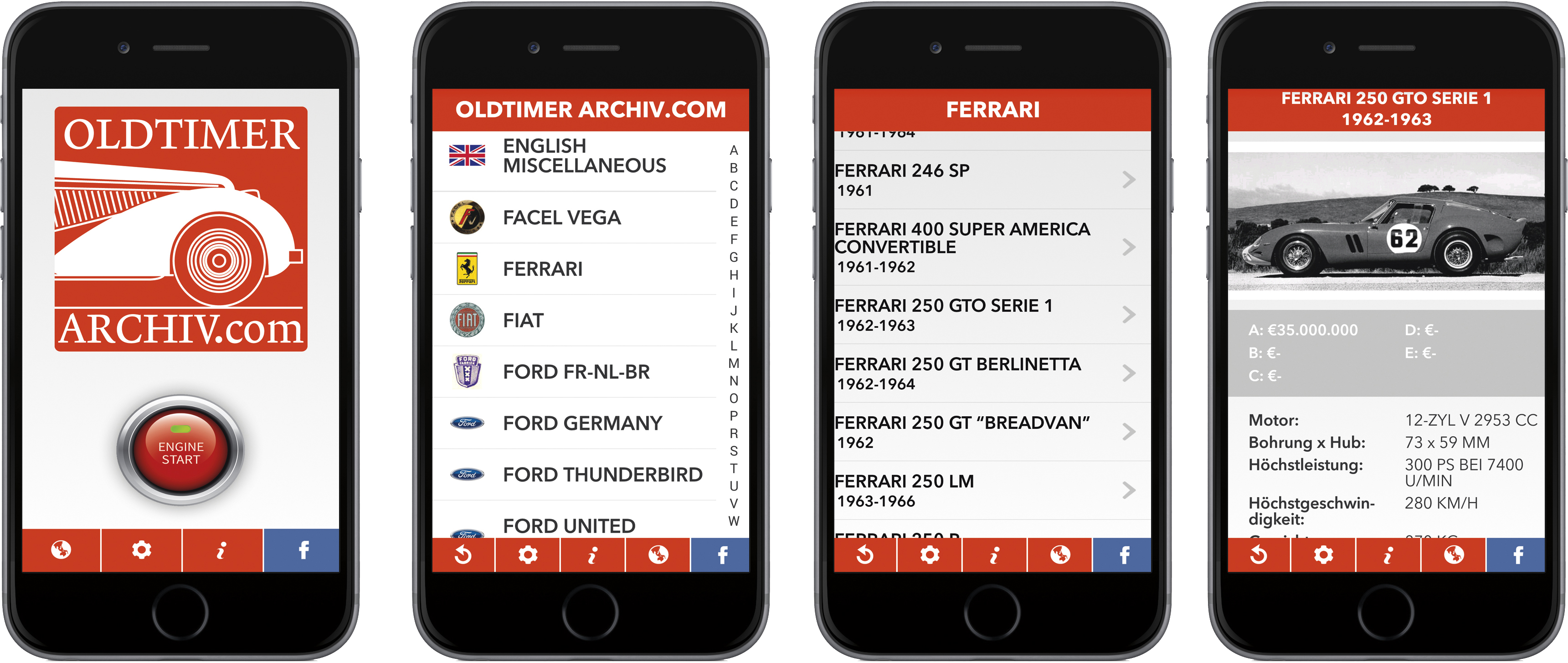 Möchten Sie die technischen Daten und / oder den aktuellen Wert aus diesem Auto?
Dann laden Sie die OldtimerArchiv.com App.
 Interessenten aus der Schweiz bestellen bitte direkt bei